
Short answer
Two capacitors stay in circuit on a two-value motor; a capacitor-start motor drops the start capacitor out once it is running. That wiring difference is what the names on our single-phase lines describe, and the number that decides the purchase is published in the same table: Tstart/Tn, the starting torque as a multiple of rated torque. On the 1.5 kW, 4-pole comparison below, the published figures run from 0.35 (MY) to 2.8 (YC and YCL), so a loaded start is a different motor purchase from an easy start.
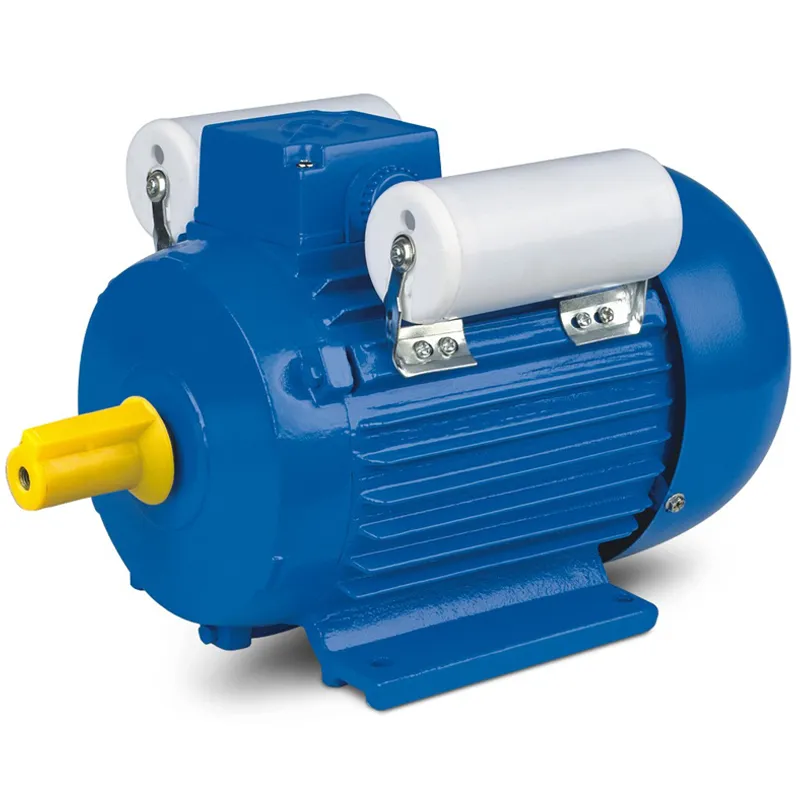
A single-phase motor needs a phase shift to start and run on a 220 V, 50 Hz supply, and a capacitor provides that shift. A two-value capacitor motor (YL on this site) uses one capacitance for starting and another for running. A capacitor-start induction motor (YC and YCL) uses a start capacitor that is taken out of circuit once the motor is up to speed. The compact aluminum-housing lines (MC, ML and MY) and the JY line are the single-capacitor single-phase options in this range.
Our tables do not publish capacitor capacitance in microfarads. The capacitor values themselves are something to request in the quotation, not something to infer from a series name. What every model table does publish is output in kW and HP, voltage (220 V), current in A, frequency (50 Hz), power factor, efficiency, speed in r/min, and the three ratios Tstart/Tn (starting torque), Ist/ln (starting current) and Tmax/Tn (maximum torque). Every figure in this guide is read from those columns or calculated from them.
How the two layouts differ
Two-value capacitor (YL)
Two capacitance values are used, one at start and one while the motor runs, and both stay connected during operation. The published starting-torque ratio for YL is 1.7 to 1.8 times rated torque, with a published starting-current ratio of 6.0.
Capacitor start (YC and YCL)
A start capacitor is used to break away a loaded machine and is disconnected once the motor is running. The published starting-torque ratio reaches 3.0 on YC and YCL, with published starting-current ratios of 6.0 to 7.0. These two heavy-duty lines publish power ranges of 0.18-7.5 kW (YC) and 0.37-7.5 kW (YCL).
Single-capacitor compact lines (JY, MC, ML, MY)
These single-phase lines are built for smaller frames and easier duties. Their published starting-torque ratios differ widely: JY publishes 2.8 to 3.0, MC publishes 2.2 to 3.0, ML publishes 2.0 to 2.2, and MY publishes only 0.35 to 0.55. That last row is the clearest warning in this guide: a low published starting torque cannot be used for a loaded start.
Choosing between them: a real 1.5 kW example
A workshop compressor has to start against load at 220 V, 50 Hz. The machine needs 1.5 kW of shaft output at 4 poles, and the buyer is comparing six published models from our tables. All figures below are the published values of those exact rows; the torque arithmetic that follows is ours, not a manufacturer curve.
| Model (1.5 kW, 4 poles) | Speed (r/min) | Eff (%) | Current (A) | Tstart/Tn | Ist/ln | Tmax/Tn |
|---|---|---|---|---|---|---|
| YL90L-4 (two-value) | 1430 | 75 | 9.44 | 1.7 | 6.0 | 1.6 |
| MC100L2-4 | 1440 | 73 | 12.5 | 2.5 | 6.5 | 1.8 |
| ML90L-4 | 1400 | 76 | 9.44 | 2.2 | 6.5 | 1.7 |
| MY90L-4 | 1400 | 75 | 9.57 | 0.35 | 5.0 | 1.7 |
| YC100L-4 (capacitor start) | 1440 | 72 | 13.5 | 2.8 | 6.5 | 2.0 |
| YCL100L-4 (capacitor start) | 1450 | 79.4 | 9.3 | 2.8 | 7.0 | 1.8 |
Here is the arithmetic that turns the published ratio into a starting torque. Rated torque in Nm is 9550 x rated kW / speed in r/min, a standard engineering conversion, not a figure from our tables. For the YL90L-4 that is 9550 x 1.5 / 1430, about 10.0 Nm, so the published 1.7 ratio gives roughly 17 Nm at start. For the YCL100L-4 it is 9550 x 1.5 / 1450, about 9.9 Nm, and the published 2.8 ratio gives roughly 28 Nm. For the MY90L-4 the same calculation gives about 10.2 Nm rated and roughly 3.6 Nm at start. The starting-torque numbers are arithmetic on the published Tstart/Tn column; the ratios and currents come from the table rows above.
The starting-current column matters just as much. YC and YCL reach 6.5 to 7.0 times rated current at start against 6.0 for the YL row, so the higher breakaway torque has to be checked against the supply and the motor protection. The comparison also stays inside one pole count: these are all 4-pole, 220 V, 50 Hz rows. A 2-pole model with the same kW runs near 2900 r/min and carries roughly half the rated torque, so it is not a like-for-like substitute.
All seven series: published ranges
The seven single-phase lines on this site publish the following ranges. Power figures are the published specification range of each series; the ratio ranges are taken across the model rows of its table.
| Series | Name on the product page | Published power | Tstart/Tn | Ist/ln | Tmax/Tn |
|---|---|---|---|---|---|
| YL | Two value capacitor | 0.37-3.7 kW | 1.7-1.8 | 6.0 | 1.6-1.8 |
| YC | Heavy duty capacitor start | 0.18-7.5 kW | 2.1-3.0 | 6.0-7.0 | 2.0 |
| YCL | Heavy duty capacitor start | 0.37-7.5 kW | 2.0-3.0 | 6.0-7.0 | 1.8 |
| JY | Single phase asynchronous | 0.18-0.75 kW | 2.8-3.0 | 6.5-7.0 | 1.8 |
| MC | Aluminum housing | 0.18-2.2 kW | 2.2-3.0 | 6.0-7.0 | 1.8 |
| ML | Aluminum housing | 0.37-3.7 kW | 2.0-2.2 | 6.5-7.0 | 1.7 |
| MY | Aluminum housing | 0.09-1.5 kW | 0.35-0.55 | 4.5-5.0 | 1.7 |
Which Keliang series to look at
- Easy starting duty, 0.37-3.7 kW. The YL two-value line publishes 1.7-1.8 times rated starting torque with a 6.0 starting-current ratio, a balanced choice for fans, pumps and workshop machines that do not start under full load.
- Loaded starting duty, up to 7.5 kW. YC and YCL publish the highest starting-torque ratios in this range, up to 3.0, and YCL also publishes efficiencies up to 79.4%. Check the 6.5-7.0 starting-current ratio against your supply before choosing them.
- Small frames and light duty. JY, MC and ML publish 2.0-3.0 starting-torque ratios in compact frames, with power ranges from 0.18 kW to 3.7 kW across the three lines.
- Very small, easy-start equipment. MY publishes 0.35-0.55 starting torque and 4.5-5.0 starting current. Use it where the load starts freely; do not specify it for a compressor that starts against pressure.
- Duty outside these ranges. Send the load type, the kW, the starting condition and the supply, and we will return a shortlist with the published rows for each candidate.
Five mistakes at the selection table
- Reading the capacitor value out of the series name. Our tables publish no microfarad value. Two value and capacitor start describe the starting arrangement, not a capacitance; ask for the capacitor specification in the quotation.
- Treating Tstart/Tn as a guaranteed breakaway torque. It is a published ratio at the rated point. Multiply it by your own rated torque as shown above, and confirm the starting condition with us.
- Ignoring the starting current. The 2.8 torque ratio of YC and YCL comes with a published 6.5-7.0 current ratio. Check that the supply and protection can carry it.
- Comparing rows at different pole counts. The same kW at 2 poles runs near 2900 r/min and at 4 poles near 1400-1450 r/min. Rated torque changes with speed, so compare like with like.
- Specifying MY for a loaded start. Its published 0.35-0.55 starting-torque ratio is the lowest in this guide and belongs on free-starting loads only.
Send us the starting condition
Tell us the load type, the rated output in kW, if it starts under load, the pole count or speed you need, and the site supply. Keliang has built single-phase motors in Fuan, China since 1991, and we will come back with the published torque and current columns for the shortlisted models side by side, plus a factory quotation.
Factory sales: +86 186 5058 3355 · Email: sales@motors-world.com · Electric motors · Download the electric motor catalogue · Send an inquiry