
Short answer
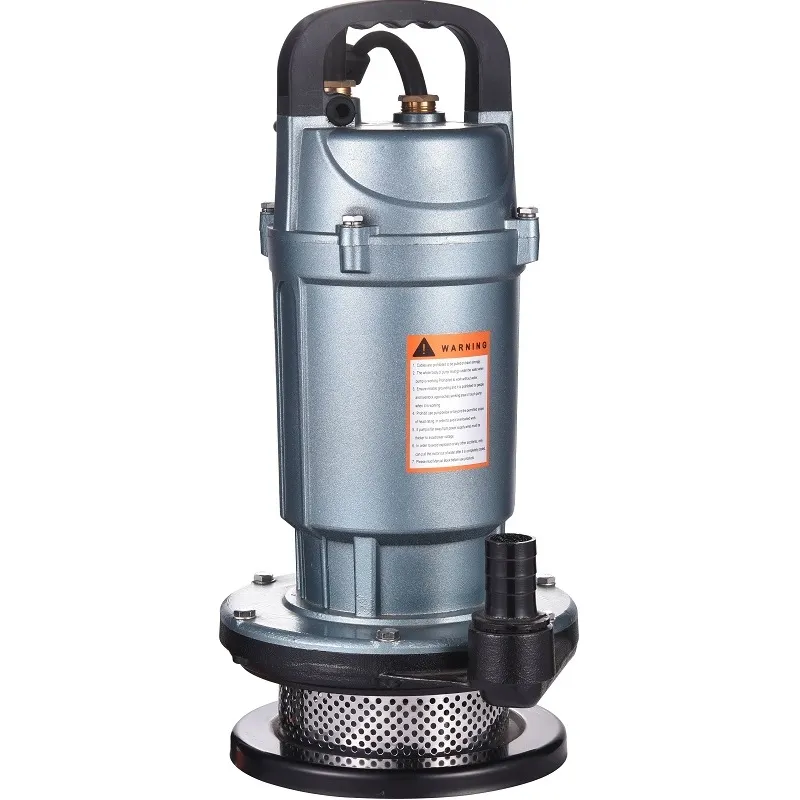
A submersible pump and a centrifugal pump can deliver the same flow and head on the same motor power. The choice between them is therefore not a performance decision - it is an installation decision. If your water sits below the pump, you need a submersible. If your water sits at or above the pump and you need a lot of flow at low head, you need a centrifugal pump. Once the family is decided, the duty point selects the model, and the model code tells you the duty point before you even open the table.
How the two families work differently
Submersible pump
The pump and its motor are lowered into the water and discharge upwards through a pipe. That single fact changes three things:
- Head is pure lift. The head figure is the vertical distance from the water surface to the discharge point. There is no suction pipe, no foot valve and no priming to think about.
- It cannot run dry. The motor is cooled by the water around it, which is also why it is quiet and why it suits unattended installations such as boreholes and tanks.
- Flow is fixed per model. Keliang submersible tables give one duty point per model - flow and head together - not a curve.
Centrifugal pump
The pump sits on the surface and draws water in through a suction pipe. It wins where the source is shallow and the demand is volume:
- High flow at low head. The DK series reaches 600 L/min at 20 m of head on a 2 kW motor.
- Flexible installation. One pump can serve several tanks or a ring main through a changeover valve.
- Performance is a curve. A centrifugal table lists several heads with the flow delivered at each, so you select the point closest to your duty.
Read the model code first
Keliang submersible model codes state the duty point. QDX10-16-0.75 means 10 m³/h, 16 m of head, 0.75 kW. QDX3-38-1.1 means 3 m³/h, 38 m, 1.1 kW. Multi-stage models add the stage count: QDX4-75/8-2.2 is 4 m³/h at 75 m, built with eight impeller stages on a 2.2 kW motor - and the head rises with the stage count across our range, from 28 m at two stages to 80 m at seven.
Two models with the same power can behave very differently, which is exactly why you should not choose a pump by kilowatt alone:
| Model | Power | Flow | Head | Outlet |
|---|---|---|---|---|
| QDX30-6-0.75 | 0.75 kW (1 HP) | 30 m³/h | 6 m | 80 mm |
| QDX10-16-0.75 | 0.75 kW (1 HP) | 10 m³/h | 16 m | 50 mm |
| QDX3-38-1.1 | 1.1 kW (1.5 HP) | 3 m³/h | 38 m | 25 mm |
Both 0.75 kW models are the same motor size. One moves 30 m³/h at 6 m, the other 10 m³/h at 16 m. Choose by the duty point you actually have.
Submersible models by duty
All figures are taken from the model tables on our product pages. Flow is given in m³/h and head in metres at the 220 V / 50 Hz rating of 2900 r/min.
| Series | Power | Flow | Head | Typical use |
|---|---|---|---|---|
| QDX | 0.25 - 2.2 kW | 1.2 - 30 m³/h | 6 - 38 m | Wells, tanks, small irrigation |
| QDX-1 (multi-stage) | 1.1 - 3 kW | 4 - 10 m³/h | 28 - 80 m | Deep lifts, pressure in the main |
| QD (multi-stage) | 0.75 - 2.2 kW | 3 - 10 m³/h | 30 - 60 m | Multi-stage household and light commercial |
| QGD | 0.37 - 1.1 kW | 1.2 - 1.8 m³/h | 50 - 140 m | Deep boreholes, small flow, high head |
| WQK | 0.55 - 3 kW | 10 - 20 m³/h | 8 - 25 m | Reservoir transfer, construction dewatering |
| WQD | 0.55 - 1.5 kW | 10 m³/h | 8 - 20 m | Fixed flow transfer duty |
| SPA | 1.1 - 2.2 kW | 6 m³/h | 28 - 52 m | Multi-stage domestic pressure |
| V-F | 0.18 - 2.2 kW | 5 - 35 m³/h | 8 - 26 m | Wide flow range, tank and pond duty |
Where a centrifugal pump is the better answer
For comparison, these are the same class of duty on our centrifugal range - the flow is shown at Q.max and the head at H.max, both taken from the model tables:
| Model | Power | Flow | Head | Outlet |
|---|---|---|---|---|
| CP-128 | 0.37 kW (0.5 HP) | 95 L/min (5.7 m³/h) | 22 m | 1″ x 1″ |
| DK 1.5DK20 | 0.75 kW (1 HP) | 170 L/min (10.2 m³/h) | 20 m | 1.5″ x 1.5″ |
| 2HCP-160 | 1.5 kW (2 HP) | 250 L/min (15 m³/h) | 61 m shut-off, 57 m at 25 L/min | multi-stage |
| DK 2.5DKM-20 | 2 kW (3 HP) | 600 L/min (36 m³/h) | 20 m | 2.5″ x 2.5″ |
Compare DK 2.5DKM-20 with QDX30-6-0.75: the centrifugal moves 36 m³/h where the submersible moves 30 m³/h, but the centrifugal needs the source at or above its own level and a primed suction line, while the submersible can sit on the floor of the pit.
Which one for your project
- Water is below the pump - a deep well, a borehole, a pit, a tank whose outlet is low: submersible. The head is simply the depth of the lift.
- Water is at or above the pump and flow is the priority - a transfer line, a sprinkler main, a large volume at low head: centrifugal. The DK series is built for exactly that envelope.
- You need a high head from a shallow source - a multi-stage centrifugal such as the 2HCP series, or a multi-stage submersible such as QDX-1.
- The pump runs unattended - a submersible cannot run dry and is quieter, which matters for borehole and tank installations.
- Water with solids - talk to us about open impeller and peripheral pump options before you order; the clean-water figures in our tables do not apply.
Five mistakes that cost buyers money
- Choosing by kilowatt. The 0.75 kW QDX30-6 and QDX10-16 deliver 30 m³/h and 10 m³/h respectively. The motor size is not the duty.
- Reading a submersible table as a curve. Each row is one operating point, not a range - there is no hidden head left at lower flow.
- Ignoring the outlet size. Outlet diameters run from 25 mm to 80 mm across our submersible range, and the small outlets belong to the low-flow models.
- Forgetting the electrical side. Our submersible tables are rated 220 V / 50 Hz at 2900 r/min; on a long cable the voltage drop eats into the available head, so cable length has to be part of the order.
- Ignoring the fluid. Every figure here refers to clean water. Solids, viscous liquids and high temperatures change the duty and the wear parts.
Send us the duty point
Give us the flow, the head, the source level, the fluid and the power supply, and we will return the model, the curve and the quotation. Keliang has manufactured pumps in Fuan, China since 1991.
Factory sales: +86 186 5058 3355 · Email: sales@motors-world.com · Download the water pump catalogue · Send an inquiry