
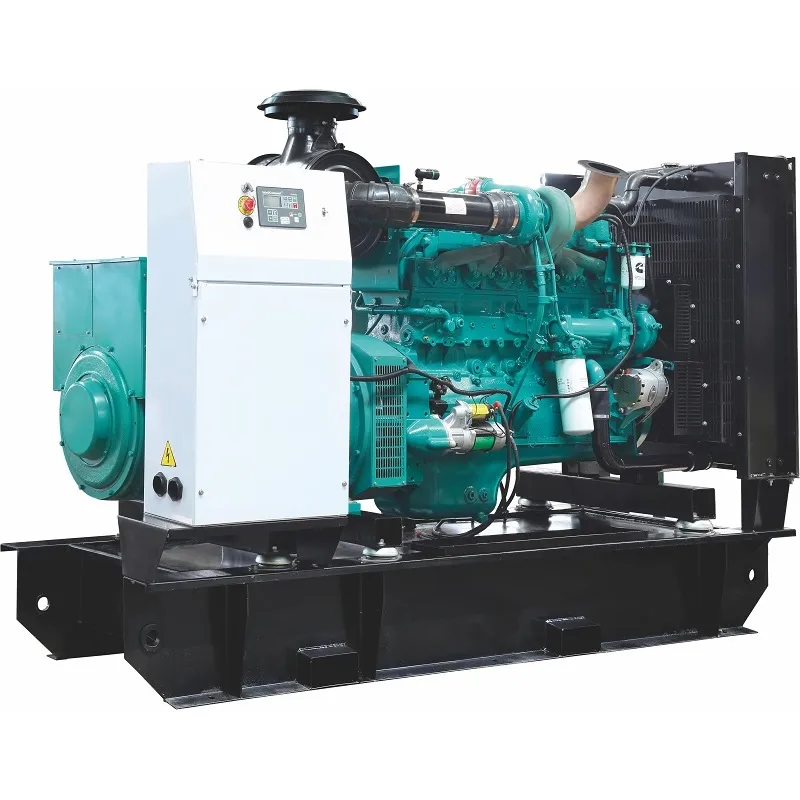
Short answer
Diesel generator fuel consumption is quoted in two units, and every Keliang model table publishes both of them: the specific consumption in g/kW.h - grams of fuel per kilowatt-hour of output - and the hourly burn in L/h. Neither number decides your fuel bill on its own, because a 500 kVA set always drinks more litres per hour than a 50 kVA set. What decides the bill is L/h per kVA multiplied by the kVA you install and the hours you run it, so that is the number to compare quotations by.
Our tables publish one consumption point per model, not a load curve. This guide shows you how to work from that single point to the three load points that decide your running costs - 50%, 75% and 100% - and how to cross-check the figures before you sign an order.
What the two consumption columns actually mean
Specific consumption (g/kW.h)
The mass of fuel the engine burns for every kilowatt-hour it delivers. This is the figure that tells you how well the engine is matched to the duty, and it is the one that moves with load: the same engine burns fewer grams per kilowatt-hour when it is working near its best point than when it is running hard.
Hourly burn (L/h)
The volume of diesel the set consumes in one hour of running. This is the figure a fuel budget is built on, and it scales with the size of the set.
Prime and standby
Each table lists every set twice: prime power for continuous running, and standby power for short-duration emergency running. The two ratings differ - the Cummins WT-C110 is 80 kW / 100 kVA prime and 88 kW / 110 kVA standby - but the fuel columns carry a single published figure for the model.
50 Hz and 60 Hz
Every table has a 50 Hz / 1500 rpm section and a 60 Hz / 1800 rpm section, and the same model code can appear in both with different consumption figures. The Cummins WT-C110 is published at 208 g/kW.h and 21.7 L/h at 50 Hz, and at 235 g/kW.h and 28.5 L/h at 60 Hz - 31% more litres per hour for the same genset rating. Always quote the frequency together with the model.
Cross-check the two columns before you order
Multiply the g/kW.h figure by the engine power in the same row and you get kilograms per hour; divide that by the L/h figure and you get the implied density in kilograms per litre, which for diesel should land close to 0.84 kg/L. For the Cummins WT-C110: 208 g/kW.h x 86 kW = 17.9 kg/h, and 17.9 kg/h / 21.7 L/h = 0.82 kg/L, so the two published columns agree. Where they do not agree, ask for the figure to be confirmed before you sign.
What changes at 50%, 75% and 100% load
Two things move in opposite directions as the load falls:
- The hourly burn falls with the load. A set carrying half of its rating burns roughly half as many litres per hour as the same set at full output.
- The specific consumption improves at part load. Below its best point the engine is asked less of it, so the grams per kilowatt-hour are lower than the published figure. The real burn at 50% load is therefore a little better than a straight line drawn from the published point.
Here is what each load point means for a buyer:
- 100% load. The published figure is your anchor. This is the point a set is sized for when it has to carry the whole site, and it is the worst case in a fuel budget.
- 75% load. A set that is a little larger than the running load burns less per hour than its published figure, but part of the capacity you paid for is idle. This is usually the sweet spot for a prime-duty plant.
- 50% load. A set sized for the peak but run at half its rating is the most expensive arrangement in fuel terms: the hourly burn is roughly half the published figure, but you paid for twice the capacity you use and the engine runs away from its best point. Where the load sits most of the time, size the set to the load that runs most of the time.
Because our model tables publish one consumption point per model, the 50% and 75% figures in the example below are arithmetic on that published point, not a manufacturer load curve. We send the load curve for the selected model with the quotation, and we work from your measured load profile.
Worked example: a 100 kVA set at 50%, 75% and 100%
Take the Cummins WT-C110 from our 50 Hz table: prime 80 kW / 100 kVA, standby 88 kW / 110 kVA, engine 6BT5.9-G1 rated 86 kW prime and 92 kW standby, published fuel consumption 208 g/kW.h and 21.7 L/h. The plant it serves runs at a measured 60 kW for most of the shift.
| Load point | Electrical load | Fuel per hour | Litres per hour |
|---|---|---|---|
| 100% of engine rating | 86 kW | 17.9 kg/h | 21.3 L/h (published 21.7 L/h) |
| 75% of engine rating | 64.5 kW | 13.4 kg/h | 16.0 L/h |
| The plant's running load | 60 kW | 12.5 kg/h | 14.9 L/h |
| 50% of engine rating | 43 kW | 8.9 kg/h | 10.6 L/h |
The arithmetic is the published specific consumption multiplied by the load and divided by 0.84 kg/L: 208 g/kW.h x 60 kW = 12.5 kg/h, which is 14.9 L/h. At the plant's real duty the set therefore burns about 31% less than the published 21.7 L/h, and since a part-loaded engine does better than the published specific consumption, treat 14.9 L/h as a conservative figure.
Now put the number on the same scale as a competitor's quotation. The published figure gives 21.7 L/h / 100 kVA = 0.217 L/h per kVA, while the set actually running the plant gives 14.9 L/h / 100 kVA = 0.149 L/h per kVA. Two sets with exactly the same rating also differ from each other: the Cummins WT-C110 is published at 21.7 L/h and the Yuchai WT-YC110 at 20.72 L/h, and across the whole 94 - 100 kVA class the L/h per kVA figure runs from 0.207 to 0.246 - about 19% between the best and the worst published figure for the same rating. Multiply that gap by the hours you run and it is the difference between two suppliers.
The same rating, side by side
All rows below are the published 50 Hz figures from our model tables. The last column is the published L/h divided by the prime kVA - our own arithmetic, not an extra specification.
| Series | Model | Prime | Standby | g/kW.h | L/h | L/h per kVA |
|---|---|---|---|---|---|---|
| Yuchai | WT-YC110 | 80 kW / 100 kVA | 88 kW / 110 kVA | 198 | 20.72 | 0.207 |
| Weichai | WT-W110 | 80 kW / 100 kVA | 88 kW / 110 kVA | 203 | 21.49 | 0.215 |
| Cummins | WT-C110 | 80 kW / 100 kVA | 88 kW / 110 kVA | 208 | 21.7 | 0.217 |
| Perkins | WT-P110 | 80 kW / 100 kVA | 88 kW / 110 kVA | 205 | 22.6 | 0.226 |
| Deutz | WT-D110F | 80 kW / 100 kVA | 88 kW / 110 kVA | 220 | 22.78 | 0.228 |
| Shangchai | WT-SC110 | 80 kW / 100 kVA | 88 kW / 110 kVA | 208 | 23 | 0.230 |
| Mitsubishi MHI | WT-M103 | 75 kW / 94 kVA | 82.5 kW / 103 kVA | 230 | 22.08 | 0.235 |
| Weichai | WT-W103 | 75 kW / 94 kVA | 83 kW / 103 kVA | 210 | 22.24 | 0.237 |
| Ricardo | WT-R104 | 75 kW / 94 kVA | 83 kW / 104 kVA | 225 | 22.24 | 0.237 |
| Shangchai | WT-SC103 | 75 kW / 94 kVA | 83 kW / 103 kVA | 208 | 23 | 0.245 |
| Xiachai | WT-XC103 | 75 kW / 94 kVA | 83 kW / 103 kVA | 218 | 23.08 | 0.246 |
Same rating, same standby power, and a difference of 4.5% in published hourly burn between the best and the worst of them. Over a year of running that is the gap between two suppliers, and it is visible before anybody turns a spanner.
Published fuel data by series
The ranges below cover the 50 Hz tables of all fifteen series we build. The hourly column is the published L/h range; rows whose hourly and specific figures do not reconcile with each other are excluded from it, and the hourly figure for such a model is confirmed against the factory curve before it goes into a quotation.
| Series | Prime power | Standby power | Fuel consumption (g/kW.h) | Published hourly burn (L/h) |
|---|---|---|---|---|
| Perkins | 7 - 1800 kW / 8 - 2250 kVA | 7.7 - 1980 kW / 9.6 - 2475 kVA | 196 - 250 | 3 - 470 |
| Cummins | 20 - 1200 kW / 25 - 1500 kVA | 22 - 1320 kW / 28 - 1650 kVA | 189 - 245 | 6.7 - 308.88 |
| Weichai | 12 - 1000 kW / 15 - 1250 kVA | 13 - 1100 kW / 17 - 1375 kVA | 203 - 238 | 4.9 - 271.76 |
| Yuchai | 30 - 1480 kW / 38 - 1850 kVA | 33 - 1628 kW / 41 - 2035 kVA | 192 - 240 | 11.16 - 410.23 |
| Yangdong | 8 - 48 kW / 10 - 60 kVA | 9 - 53 kW / 11 - 66 kVA | 220 - 255 | 3.3 - 14.2 |
| Deutz | 10 - 480 kW / 13 - 600 kVA | 11 - 528 kW / 14 - 660 kVA | 203 - 238 | 3.92 - 129.41 |
| Kubota | 6 - 28 kW / 8 - 35 kVA | 6.6 - 30.8 kW / 8 - 39 kVA | 233 - 247 | 1.89 - 8.91 |
| MAN | 360 - 704 kW / 450 - 880 kVA | 400 - 800 kW / 500 - 1000 kVA | 194 - 209 | confirmed per model |
| MTU | 220 - 2400 kW / 275 - 3000 kVA | 242 - 2600 kW / 303 - 3250 kVA | 190 - 221 | 55.8 - 585.04 |
| Ricardo | 20 - 280 kW / 25 - 350 kVA | 22 - 308 kW / 28 - 385 kVA | 195 - 258 | 9.14 - 77.18 |
| Shangchai | 20 - 600 kW / 25 - 750 kVA | 22 - 660 kW / 28 - 825 kVA | 192 - 235 | 8.2 - 166.94 |
| Xiachai | 10 - 100 kW / 13 - 125 kVA | 11 - 110 kW / 14 - 138 kVA | 218 - 231 | 3.72 - 28.21 |
| Yanmar | 5 - 48 kW / 6 - 60 kVA | 6 - 52.8 kW / 7 - 66 kVA | 220 - 265 | 1.71 - 13.17 |
| Lijia | 12 - 42 kW / 15 - 53 kVA | 13 - 46 kW / 17 - 58 kVA | 220 - 246.2 | 4.63 - 13.2 |
| Mitsubishi MHI | 5 - 1800 kW / 6 - 2250 kVA | 5.5 - 1980 kW / 7 - 2475 kVA | 205 - 300 | 2.11 - 456.62 |
Which series for which duty
- Small sets up to 40 kVA standby - Kubota, Yanmar, Yangdong, Lijia and the smaller Mitsubishi MHI and Xiachai models. The published hourly burn starts at 1.71 L/h (Yanmar WT-YM7, 5 kW prime / 6 kVA), and the specific consumption of these small engines sits between 220 and 265 g/kW.h.
- Working sets from 20 to 200 kVA prime - Cummins, Deutz, Weichai, Yuchai, Shangchai, Ricardo, Xiachai and Perkins. This is the band where the published figures are densest, and where L/h per kVA is the cheapest way to compare quotations.
- Large sets from 220 kW to 2400 kW prime - MTU, MAN, Mitsubishi MHI, Perkins, Weichai, Yuchai, Shangchai and Deutz. The biggest engines in the range publish the lowest specific consumption, 190 - 221 g/kW.h on the MTU table, and the published hourly burn climbs to 585.04 L/h on the MTU WT-MT3200.
Every one of these series is available as an open type and as a silent type, and the size and the weight of both versions are published in the same model tables.
Five mistakes that cost buyers money
- Comparing sets by L/h instead of L/h per kVA. A 500 kVA set always burns more litres per hour than a 50 kVA set. That is size, not efficiency. Divide by the kVA before you compare.
- Reading the published figure as a load curve. Each row carries one consumption point. It is not a range, and there is no hidden second figure at 50% load.
- Comparing a 50 Hz figure with a 60 Hz figure. The same Cummins WT-C110 is published at 21.7 L/h at 50 Hz and 28.5 L/h at 60 Hz.
- Sizing the set to the peak and running it at half load. The hourly burn looks cheap, but you paid for twice the capacity and the engine spends its life away from its best point.
- Signing without the load curve, the run hours and a confirmed hourly figure. Send us the measured load profile and we work from it, rather than from a single table row.
Send us the load profile
Give us the running load in kW, the hours per day, the frequency (50 Hz or 60 Hz), the duty (prime or standby) and the site conditions, and we will return the model, the load curve and the factory quotation. Keliang has been building diesel generator sets in Fuan, China since 1991.
Factory sales: +86 186 5058 3355 · Email: sales@motors-world.com · Diesel generator sets · Download the generator set catalogue · Send an inquiry