
Short answer
The efficiency column in every Keliang model table is the number to compare before you buy: at the same rated output, an IE3 motor draws less electrical input than an IE2 motor, so the same machine costs less to run for the same work. The four premium lines this site publishes make that visible row by row - YE2 (IE2) and YX2 (IE2) cover 0.18-18.5 kW and 0.55-375 kW, YE3 (IE3) and YX3 (IE3) cover 0.75-22 kW and 0.18-315 kW - and every row carries rated output, current, efficiency and power factor together.
Efficiency is the share of electrical input a model turns into mechanical output: output in kW divided by input in kW, in percent. The IEC efficiency class is the certified envelope around that tested figure; the tables publish the figure itself for every model, so every number in this guide is read from those tables or calculated from them.
This guide explains how to read the efficiency columns, how to turn them into kilowatt-hours with a real 15 kW example, which Keliang series to shortlist, and the five mistakes that cost money at the selection table.
How to read the IE2 / IE3 efficiency columns
The tables on each motor series page follow one layout, so you can read them the same way whatever the series:
- Rated power (kW / HP). The output the motor is built to deliver continuously, shown in kW and HP side by side.
- Rated current (A). The current drawn at the rated voltage of that row. The voltage differs by series - YE2 publishes 380/400/415 V columns and YE3 publishes a 400 V column - so always quote the voltage together with the model.
- Efficiency (Efficiency η(%) / Eff (%) / EFF %). The published efficiency at rated output, in percent. YE2, YX2, YX3, Y, Y2 and MS publish one figure per model; YE3 publishes three figures per model, at 100%, 75% and 50% of full load, so you can see how the efficiency moves when the load falls.
- Power factor (cosΦ). Published beside the efficiency because together they set the electrical input: input power = output / (efficiency x power factor).
Three series on this site also carry the line IE2/IE3 high efficiency in their short description - Y, Y2 and MS - but that sentence is a generic template, not a certification. The only number that belongs in your decision is the published efficiency column in the model table.
Choosing between IE2 and IE3: a real 15 kW example
The method needs four inputs: the rated output your machine really needs, the hours per year it runs, the site voltage and frequency, and the duty (continuous or intermittent). Fix those four and the rest is arithmetic on the published efficiency column - input power = rated output / efficiency, then the input difference multiplied by your own running hours.
A packaging line runs 15 kW of shaft output at 50 Hz, 2 poles, 6,000 hours per year, on a 400 V supply. Both candidates are published in our tables: the YE2-160M2-2 (IE2) and the YE3-160M2-2 (IE3).
| Criterion | YE2-160M2-2 (IE2) | YE3-160M2-2 (IE3) |
|---|---|---|
| Rated output | 15 kW | 15 kW |
| Published efficiency at 100% load | 89.0% | 92.4% |
| Published full-load current at 400 V | 27.4 A | 25.7 A |
| Electrical input at rated output | 16.85 kW (= 15 / 0.890) | 16.23 kW (= 15 / 0.924) |
| Annual electricity at 6,000 h | 101,100 kWh (= 16.85 x 6,000) | 97,400 kWh (= 16.23 x 6,000) |
| Annual difference | about 3,700 kWh less with the IE3 motor - arithmetic on the two published efficiency values | |
The published full-load current tells the same story at the same voltage: 27.4 A against 25.7 A at 400 V. Every figure in the table comes from the two model rows, and the difference between them is arithmetic - not a manufacturer load curve, not a test-cell result and not a guarantee. Replace 6,000 hours with the hours your plant really runs: a few hundred hours a year shrinks the difference to almost nothing, several thousand hours grow it.
Published efficiency: IE2 vs IE3, model by model
At 50 Hz, 2 poles, the published efficiency columns of the two YE lines line up like this:
| Rated output | YE2 model (IE2) | YE2 efficiency (%) | YE3 model (IE3) | YE3 efficiency at 100% load (%) | Difference (points) |
|---|---|---|---|---|---|
| 0.75 kW | YE2-80M1-2 | 75.0 | YE3-80M1-2 | 81.2 | +6.2 |
| 1.5 kW | YE2-90S-2 | 78.5 | YE3-90S-2 | 84.8 | +6.3 |
| 3 kW | YE2-100L-2 | 82.6 | YE3-100L-2 | 87.8 | +5.2 |
| 7.5 kW | YE2-132S2-2 | 87.0 | YE3-132S2-2 | 90.8 | +3.8 |
| 15 kW | YE2-160M2-2 | 89.0 | YE3-160M2-2 | 92.4 | +3.4 |
| 18.5 kW | YE2-160L-2 | 90.0 | YE3-160L-2 | 92.8 | +2.8 |
The same arithmetic on the high-power pair - YX2 (IE2) against YX3 (IE3) across their overlapping 0.55-315 kW range - gives a gap of +0.1 point at 0.75 kW, +3.2 points at 1.1 kW, and between +0.8 and +1.0 point from 15 kW to 90 kW at 2 poles. The gap is widest in the small frames and settles in the large ones, while the premium lines still reach 22 kW (YE3) and 315 kW (YX3). The difference column above and these gaps are arithmetic on published figures, and each row is the single figure its table publishes for that model.
Which Keliang series to look at
The seven three-phase lines on this site map the decision by rated output, voltage and the efficiency column each one publishes:
| Series | IEC class as published | Rated output | Rated voltage | Published efficiency column | Published range |
|---|---|---|---|---|---|
| YE2 | IE2 | 0.18-18.5 kW | 380/400/415 V | Efficiency η(%) | 56.0% at 0.18 kW to 90.0% at 18.5 kW |
| YX2 | IE2 | 0.55-375 kW | 380 V | Efficiency n% | 77.4% at 0.75 kW to 95.1% at 315 kW |
| YE3 | IE3 | 0.75-22 kW | 400 V | Efficiency η% at 100%, 75% and 50% load | 79.2% at 0.75 kW to 93.3% at 22 kW |
| YX3 | IE3 | 0.18-315 kW | 380 V | EFF % | 52.0% at 0.18 kW to 95.8% at 250 kW |
| Y | not stated in the table | 0.55-200 kW | 380 V | Eff (%) | published for every model |
| Y2 | not stated in the table | 0.18-315 kW | 380 V | Eff(%) | published for every model |
| MS | IE2 marked in the model codes of one section | 0.06-18.5 kW | 220 V | Eff (%) | published for every model |
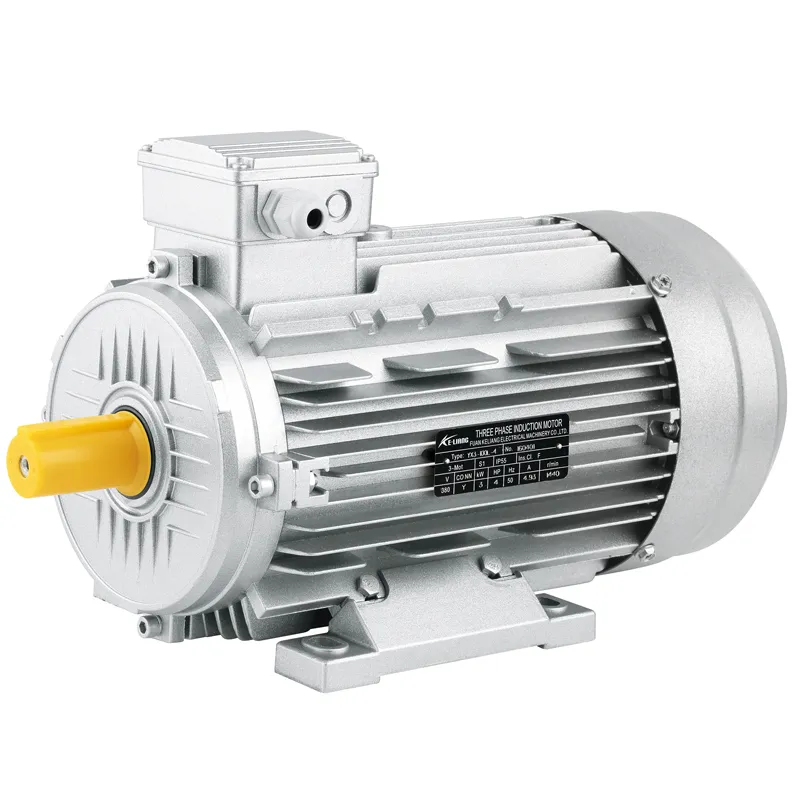
How to read the range: if the machine runs a few hundred hours a year, the standard IE2 line (YE2 or YX2) is normally enough; if it runs thousands of hours a year, the IE3 line pays back on the kilowatt-hour difference calculated above. Y and Y2 are the entry-level induction lines and MS is the aluminium-housing line for the small frames - all three publish their own efficiency column, so the same arithmetic applies to them. For a duty that sits outside these ranges, send us the operating profile and we will come back with a shortlist and the published figures for each candidate.
Five mistakes at the motor selection table
- Reading IE2 and IE3 as a different speed or voltage. IE2 and IE3 motors share frame sizes, rated outputs and speeds; they differ in the efficiency envelope. The model you order still has to match your line voltage (YE2 is published at 380/400/415 V, YE3 at 400 V) and your frequency.
- Comparing current rows at different voltages. The same model is published in several voltage columns, so compare at one voltage - the 400 V column is common to both YE2 and YE3 - and quote your supply voltage together with the model.
- Trusting the line IE2/IE3 high efficiency on Y, Y2 and MS. That sentence is a generic template in the short description, not a certification; the published Eff column is the figure that goes into your calculation.
- Sizing the motor with no hours behind the decision. The energy difference scales with the running hours. A few hundred hours a year will rarely justify the premium; several thousand hours a year may.
- Signing without the efficiency figure in the quotation. Ask for the published efficiency figure of the exact model in the quotation, so the number you buy against is the number in the table.
Send us the operating profile
Send the rated output in kW, the hours per year it really runs, the site voltage and frequency, and the duty (continuous or intermittent). Keliang has been building electric motors in Fuan, China since 1991, and we will come back with the model family, the published efficiency figures for the shortlisted models side by side, and a factory quotation.
Factory sales: +86 186 5058 3355 · Email: sales@motors-world.com · Electric motors · Download the electric motor catalogue · Send an inquiry